MLOps services

MLOps Services That Take Your Models Into Production

Netofficials delivers MLOps services and ML pipeline development for teams whose models work in notebooks but not reliably in production. One cross-functional team, led by a named delivery lead, builds repeatable training, deployment and monitoring pipelines inside your stack, with a client review every sprint. Send a short brief to start.

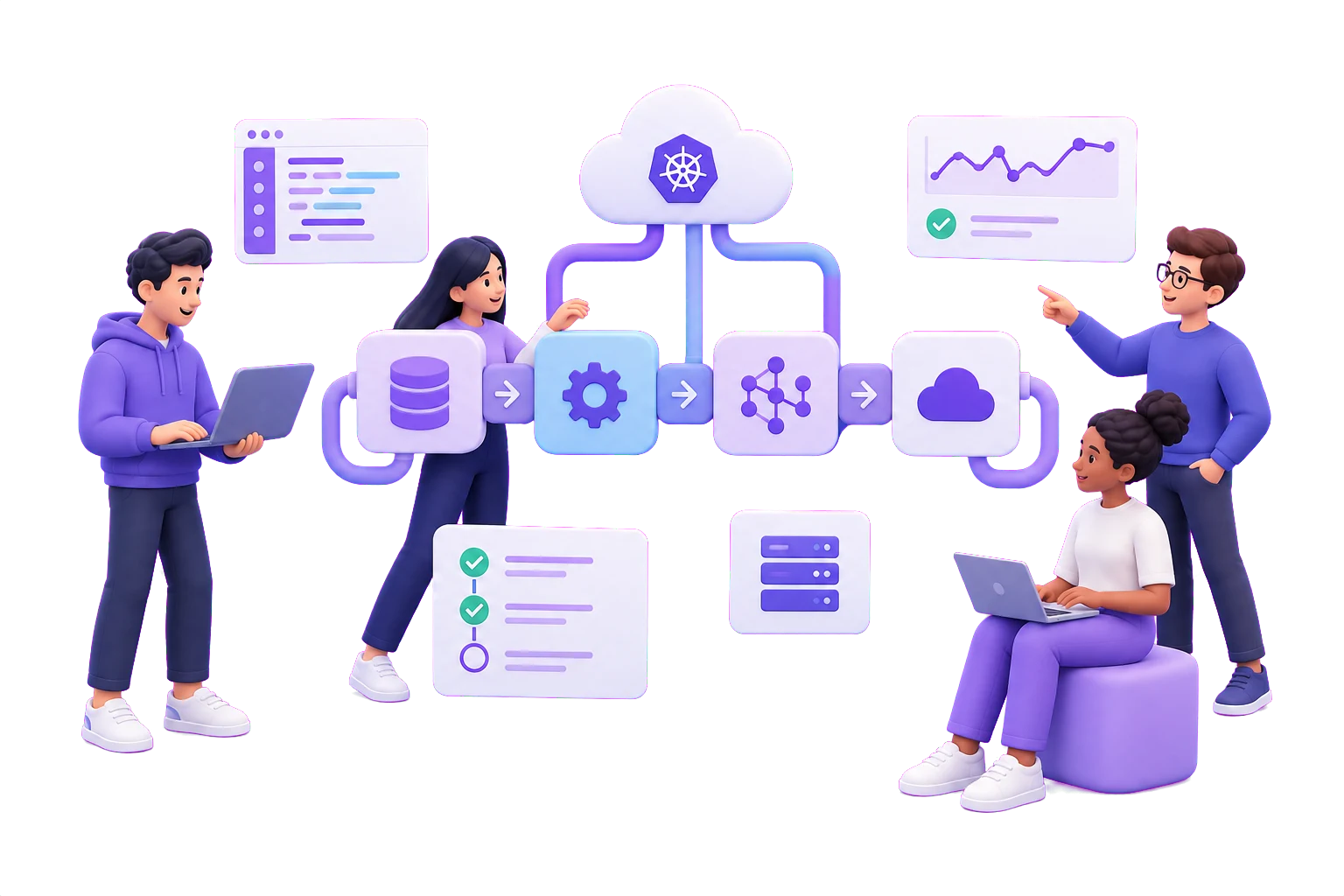
Illustration of a connected team building a machine learning pipeline
Delivery
One cross-functional team covering back-end, QA and DevOps builds your ML pipelines from a written discovery scope.
Contact
A named delivery lead owns day-to-day progress and keeps you informed, with a technical architect accountable for system design.
Ownership
The contract confirms IP assignment for your pipeline code before the build begins.
Reviews
Every sprint ends with a client-facing review, and the communication window and update cadence are agreed before work starts.
What you get

From notebook model to monitored production pipeline

Training and deployment pipelines

We turn your experiment code into automated pipelines for data preparation, training, validation and deployment. Each run is repeatable, so you stop depending on one person's notebook or a manual handover. You get versioned models, tracked experiments and a release path your engineers can read, rerun and extend.

Model serving and integration

We put your models behind a batch job or a real-time API, connected to the applications and data sources that depend on them. Staging and production environments are set up with the deployment steps documented. That lets your product team ship model updates without rebuilding the integration each time.

Monitoring and retraining

Production models degrade as data changes. We set up monitoring for model performance, data drift and pipeline failures, with alerts routed to your team. Retraining triggers are agreed with you in writing, so you decide when a model is refreshed and how a bad release is rolled back.

Who it suits

MLOps for teams whose models stall before production

  • Trained models in notebooks that need a repeatable training and deployment pipeline
  • Live models with no monitoring for drift, failures or retraining triggers
  • Data science teams that need engineers to build the production path around their models
Illustration of a connected team working on a shared product plan
How an MLOps project runs

How an MLOps engagement runs, stage by stage

  1. Discover

    You walk us through your models, data sources, current training process and where releases break down. We put the pipeline goals and first-release boundaries into a written discovery scope.

    You receive
    • Written discovery scope
    • Model and data inventory
    • Initial estimate

    You agree the written discovery scope

  2. Design

    You review the proposed pipeline architecture for training, deployment and monitoring, along with the environments and tooling it will use. Our technical architect explains the system design and technology choices so you can challenge them early.

    You receive
    • Pipeline architecture notes
    • Deployment environment plan
    • Monitoring approach

    You approve the architecture before development starts

  3. Build

    We develop the pipeline components in sprints, covering data and feature steps, automated training, model deployment and monitoring. You see working builds rather than status slides.

    You receive
    • Staging pipeline builds
    • Sprint review notes
    • Pipeline test results

    You review the pipeline at the end of every sprint

  4. Validate

    We test the pipeline end to end against the acceptance criteria you agreed. That includes retraining runs, deployment steps, rollback and the monitoring alerts your team will depend on.

    You receive
    • Acceptance criteria checklist
    • QA test report
    • Open issue log

    You accept the pipeline against the agreed criteria

  5. Release

    Netofficials deploys the training, deployment and monitoring pipelines to your production environment. You then receive the documentation and deployment access your team needs to run and extend them.

    You receive
    • Production pipeline release
    • Handover documentation
    • Deployment access

    You confirm the handover of documentation and access

Ready to scope your MLOps pipeline?

Send a short brief covering your models, data sources and where they run today, and we reply with questions, a proposed scope and the team to deliver it, or a different approach if MLOps is not the right fit.

Start my brief
Decisions before estimates

What shapes your MLOps scope and estimate

Models, data and pipeline stages

Your estimate starts with how many models you run and how each one is trained, validated and retrained. We list the data sources feeding them, whether the pipeline is batch or real-time, and which stages need automation. That list sets the size of the work and removes surprises from the written discovery scope.

Integrations and environments

Cost and timing also depend on where the pipeline has to run and what it connects to. We map your cloud or on-premise environments, data warehouses, feature stores, CI/CD tooling and the applications that call the models. Knowing this early removes rework when deployment access and handover are planned.

Monitoring, ownership and support

Decide who watches models once they are live. We agree what to monitor, such as prediction quality, data drift and pipeline failures, who responds, and what your team needs to run it alone. Documentation and deployment access are handed over at release. If MLOps is not the right fit, we will recommend another approach after scoping.

Engagement models

Choose how we build your ML pipelines

Project delivery

Fixed-price delivery of a defined MLOps scope, such as a training-to-deployment pipeline with monitoring, for teams that know which models and systems are involved.

  • Models, data sources and acceptance criteria written into the scope before delivery starts
  • A client-facing review at the end of each sprint to check pipeline progress against the plan
  • New models, data sources or environments added mid-project go through a change request

Dedicated team

An India-based development team that works through your MLOps roadmap over time, suited to companies with several models to take into production.

  • A cross-functional team with back-end, QA and DevOps skills matched to your ML stack
  • Your product owner sets sprint priorities for ML pipeline work such as retraining, deployment and monitoring
  • Source code, pipeline definitions and model-serving configuration are yours, with IP assignment confirmed in the contract before the build

Staff augmentation

Individual engineers who join your data science or platform team to add pipeline automation, deployment and monitoring skills inside your existing process.

  • Engineers with MLOps skills, for example in pipeline orchestration, model deployment or monitoring, join your existing team
  • Engineers use your repositories, CI/CD, cloud accounts and ticketing, so ML pipelines stay in the stack you already run
  • Meeting schedule, update cadence and overlap hours are set with you up front, so pipeline work stays in step with your team
Technology around your pipelines

MLOps tooling chosen to fit your stack

Netofficials confirms your MLOps tooling in the written discovery scope, so nobody is surprised by it mid-build. The technical architect, who is accountable for technology selection, bases the choice on your existing cloud, data and CI/CD setup, the frameworks your models already use and who will run the pipelines after release. You avoid a rebuild around tools your team does not want to maintain, and you receive documentation and deployment access at handover.

ReactNode.jsPythonPostgreSQL
Before you enquire

MLOps questions to settle before you send a brief

What do MLOps services cost, and how long does a project take?

Cost and timing depend on the scope we agree in writing, not on a fixed rate card. The main drivers are the number of models, the data sources feeding them, the integrations with your existing systems, and the environments the pipeline must run in, such as development, staging and production. Netofficials sets out assumptions, review milestones and commercial terms before delivery begins, and we confirm the estimate after the written discovery scope. Send a short brief and we will reply with questions and a proposed scope.

Who owns the pipeline code, and how will we communicate?

You own the code. IP assignment is confirmed in the contract before the build begins, so the training, deployment and monitoring pipelines we write for you are yours. A named delivery lead owns day-to-day progress and communication, and you have one point of contact throughout. We agree the communication window, meeting schedule and update cadence with you before work starts, and each sprint ends with a client-facing review. At release we hand over documentation and deployment access.

Can you work inside our stack and with our data science team?

Yes. We can build around your cloud environment, tools and the models your data scientists already have, with responsibilities and review points agreed together. Choose fixed-price project delivery for a defined pipeline, a dedicated India-based team for an ongoing roadmap, or staff augmentation to add engineers to your team. If MLOps is not the right step for your situation, we will recommend a different approach after scoping.

Send a brief for your MLOps pipeline

Tell us which models you have, where they run today and what keeps them from running reliably in production. We reply with questions and a written scope for your training, deployment and monitoring pipeline, and with the engagement model that fits. A named delivery lead handles your communication. IP assignment is confirmed in the contract before the build begins. If MLOps is not the right fit, we will recommend another approach after scoping.

Talk about your project